He Marched Them Up to the Top of the Hill Then Marched Them Down Again
| "The Thou Onetime Knuckles of York" | |
|---|---|
| Nursery rhyme | |
| Published | 1642 |
| Songwriter(s) | unknown |
"The Grand Old Duke of York" (also sung as The Noble Duke of York) is an English children's nursery rhyme, often performed as an action vocal. The eponymous knuckles has been argued to be a number of the bearers of that title, especially Prince Frederick, Duke of York and Albany (1763–1827) and its lyrics take go proverbial for futile action. Information technology has a Roud Folk Song Index number of 742.
Words [edit]

Statue of Frederick, Duke of York, in Waterloo Place, Westminster, London
A modernistic version is:
Oh, the grand onetime Duke of York,
He had x thousand men;
He marched them upwards to the top of the colina,
And he marched them down again.When they were upwards, they were up,
And when they were down, they were downward,
And when they were only halfway upward,
They were neither up nor down.[1]
Origins [edit]
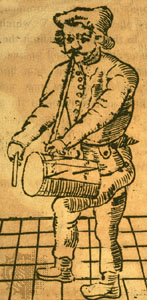
Richard Tarlton in the 1580s with his pipe and tabor
Like many popular plant nursery rhymes the origins of the vocal have been much debated and remain unclear. Unusually the rhyme clearly refers to an historical person and debates have tended to circulate around identifying which Duke is being referred to in the lyrics.[one] The lyrics were non printed in their mod form until relatively recently, in Arthur Rackham's Mother Goose in 1913.[2] Prior to that a number of alternatives take been establish including a note that in Warwickshire in 1892 the vocal was sung of both the Duke of York and the King of French republic; from 1894 that it was sung of Napoleon.[1] The oldest version of the song that survives is from 1642, under the title 'Old Tarlton's song', attributed to the stage clown Richard Tarlton (1530–1588) with the lyrics:
The King of France with forty thousand men,
Came upward a hill and so came downe againe.[3]
As a result, the argument has been fabricated that it may have been a common satirical poesy that was adjusted as advisable and, because information technology was recorded in roughly the modernistic course, has go stock-still on the Knuckles of York.[1] Candidates for the duke in question include:
- Richard, Knuckles of York (1411–1460), who was defeated at the Battle of Wakefield on 30 December 1460. Richard's regular army, some 8,000 potent, was awaiting reinforcements at Sandal Castle in Wakefield (the castle was built on top of a Norman motte). He was surrounded by Lancastrian forces some three times that number, just chose to sally forth to fight. Richard died in a pitched battle at Wakefield Dark-green, together with between one third and one half of his army.[4]
- James Two (1633–1701), formerly Duke of York, who in 1688 marched his troops to Salisbury Plain to resist the invasion from his son-in-police force William of Orangish, simply to retreat and disperse them every bit his back up began to evaporate.[v]
- The most common attribution is to Prince Frederick, Duke of York and Albany (1763–1827), the 2d son of King George 3 and Commander-in-Chief of the British Army during the French Revolutionary Wars and the Napoleonic Wars.[1] His most pregnant field command was during the Flanders Entrada of 1793–94. Despite the British troops having some success against the French, in the summer of 1794 the Duke was obliged to retreat into the netherlands and he was subsequently recalled to England.[6] Flanders having something of a reputation for beingness flat, the specific location of the "hill" in the nursery rhyme has been suggested to be the town of Cassel which is built on a hill which rises 176 metres (about 570 feet) in a higher place the flat lands of French Flemish region in northern France.[i] Apart from the ducal championship in the song and the events of their lives at that place is no external evidence to link the rhyme to any of these candidates.
Song [edit]
"The Grand Old Duke of York" is also sung to the melody of "A-Hunting We Will Get".[7]
Dutch version [edit]

A Dutch accommodation of the vocal replaces the Duke of York with Maurice, Prince of Orange (1567–1625), whose exercise of training mercenaries (completely new, and mocked at first) became famous following his success in war. It is not known when the British song crossed the N Sea, just nowadays information technology is well-known within the Dutch scouting movement.[8]
| De held prins Maurits kwam | The hero Prince Maurice came |
References [edit]
- ^ a b c d east f I. Opie and P. Opie, The Oxford Dictionary of Plant nursery Rhymes (Oxford Academy Printing, 1951, 2d edn., 1997), pp. 442–443.
- ^ East. Knowles, Oxford Dictionary of Quotations (Oxford: Oxford University Press, 1941, 6th edn., 2004).
- ^ J. Orchard Halliwell-Phillipps and Henry Chettle, eds, Tarlton'south Jests: And News Out of Purgatory (Oxford: Oxford University Press, 1844), p. xxix.
- ^ J. Swinnerton, The History of Britain Companion (Robson, 2005), p. 149.
- ^ C. Roberts, Heavy words lightly thrown: the reason behind the rhyme (Granta, 2004), p. 44.
- ^ J. Black, Britain as a military ability, 1688–1815 (London: Routledge, 1999), p. 195.
- ^ Cub Lookout man Songbook. Boy Scouts of America. 1955.
- ^ "De held prins Maurits". Scouting Marca Appoldro. Retrieved i September 2016.
Source: https://en.wikipedia.org/wiki/The_Grand_Old_Duke_of_York
0 Response to "He Marched Them Up to the Top of the Hill Then Marched Them Down Again"
Enregistrer un commentaire