Mapa Con Leyenda De Los Primeros Pobladores Clip Art Mini Arrow Pointing to the Left
-
California and the Civil War - 1st Battalion of Native Cavalry, California Volunteers
-
- Introduction First Battalion of Native Cavalry
Prepared by Dr. Albert Vela, Ph.D. - Introduction First Battalion of Native Cavalry
- Extracted from "Records of California Men in the State of war of the Rebellion, 1861 To 1867." 1890. pp 304-306.
- Transcribed by Sandy Neder.
-
The extraordinary horsemanship displayed by the native Californians led to the conventionalities that a battalion of cavalry, composed entirely of such, would render excellent service in Arizona. Appropriately a telegram, a copy of which is hither inserted, together with the reply, was sent to the State of war Department. -
[Telegram.]
San Francisco, December 19, 1862.To Aide-General L. Thomas:
I request authority to raise four companies of native cavalry in the Los Angeles Commune, to be commanded by a patriotic gentleman, Don Andreas Pico.
1000. WRIGHT
Brigadier-General[Telegram.]
War Section, Adjustant-General'south Office,
Washington, Jan 20, 1863.
To General Wright, San Francisco, Cal.:Secretarial assistant of State of war gives dominance to heighten four companies native cavalry in Los Angeles District.
- Thomas M. Vincent,
- Brigadier-General
- Assistant Adjutant-General
- A favorable response having been received, the officers were appointed and the piece of work of recruiting the battalion commenced. Don Andreas Pico, of Los Angeles, then Brigadier-General of the First Brigade of California militia, was commissioned Major of the battalion. He, however, declined the commission, on the basis of sickness and his inability to ride on horseback.
- General Pico having declined, Salvador Vallejo was commissioned Major of the battalion. He was not mustered equally such, nonetheless, until Baronial 13, 1864. He resigned in February, 1865, and was succeeded by John C. Cremony, who had been a Captain in the Second California Cavalry, and, with his company, constituted part of the 'California Cavalcade" during its march to, and service in, New Mexico.
- Considerable delay was experienced in raising men for this battalion. Recruiting commenced in February, 1863, but the first company was not filled upward and mustered until September seventh, aforementioned year. The other companies were non mustered in until the leap and summer of 1864.
-
The battalion was stationed in diverse places in California, equally shown by the table published herewith. During the summertime of 1865, it was taken by Major Cremony to Arizona and stationed in the southern role of that territory, until early on in 1866, when it was returned to California to be mustered out. The tabular array on page vii will give the dates of mustered in and muster out of the companies. Companies A, B, and D were mustered out at Drum Barracks; Company C was mustered out at Presidio, San Francisco. - The records of this battalion are very incomplete, and for that reason it is impossible to give a full account of the service rendered by it. In that location seems to take been an unusually large number of desertions from it. From 1 company in that location were more than fifty; from another, about eighty.
-
The post-obit is the correspondence and remarks on muster rolls found relating to this battalion: -
-
General Headquarters, State of California
Adjutant-General'due south Office, Sacramento, June 2, 1864. -
General: Colonel Curtis' letter of the alphabet has been read by me, and in reply to your inquiry every bit to whether the Governor has authorized Don Antonio de la Guerra to raise a company, I have to state that the Governor did not specially authorize him to raise a company, but that he, on yesterday, concluded to have his visitor (known as the Santa Barbara Company), and has directed commissions to issue, which has accordingly been done and forwarded to Colonel Drum to-day, for the following officers: Captain, Antonio G. de la Guerra; First Lieutenant, Santiago de la Guerra; Second Lieutenant, Porfino Jimeno. -
The recommendation for the Fourth Infantry, California Volunteers, I have duly forwarded to his Excellency the Governor. -
Respectfully, your obedient servant, -
Geo. S. Evans
Adjutant-General, State of California.George Wright, Brigadier-Full general U.Due south. Army, Commanding Section of Pacific
-
State of California, Executive Department
Sacramento, March 27, 1865 -
Colonel: I enclose a memorandum of the officers already commissioned for the native battalion, equally appears from the books of the Adjutant-General. -
I take the General's recommendation for Mr. Leese and some other men (I think) for a commission in this battalion. -
Mr. Leese was commissioned past me equally Adjutant, but could not be mustered in. -
From this date it appears that there are no vacancies to make full; and even one or more of the 2d Lieutenants that I have appointed have not been mustered in, for the reason that their companies were beneath the minimum.
Information technology seems to me that all these companies should be recruited to to a higher place the minimum before they leave for Arizona. I am informed that the companies could easily get recruits plenty to fill them up in Monterey Canton if any attempt was made to do information technology. Delight call the Full general's attention to the thing. -
Truly yours, -
F. F. Low,
Governor. -
To Lieut.-Col. R.C. Drum.
-
[Inclosure.] -
Company A, Rose R. Pico, Captain; Crisanto Soto, First Lieutenant; M.E. Jimenez, Second Lieutenant.
Visitor B, Porfino Jimeno, Captain; John Lafferty, Commencement Lieutenant; J.Chiliad. Donevan, Second Lieutenant.
Company C, Antonio M. de la Guerra, Helm; Santiago de la Guerra, First Lieutenant; ---- Coddington, Second Lieutenant.
Company D, Edward Bale, Helm; J. Clement Cox, First Lieutenant; Francisco F. Guiraido, 2d Lieutenant.
Note: Company C is the but one that has the minimum number of privates.
-
Remarks on Muster Roll of Company A, Showtime Battalion Native Cavalry, for March and Apr, 1865. -- Pursuant to orders from Headquarters Benicia Billet, Cal., a detachment of twenty-five enlisted men in control of 2d Lieutenant M.E. Jimenez, proceeded, on the twenty-3rd of Apr, to Green Valley and arrested and brought to solitude ten marauders. A fight ensued, wounding private Antonio Guilman and Juan Leon, both severely.
-
Remarks on Return of Company B, Start Battalion Native Cavalry, for May 1865. -- Outset Lieutenant John Lafferty and five enlisted men left Military camp Low, San Juan, Cal., April x, 1865, in pursuit of the murderers Jason and Henry, per Post Society No. 3, Headquarters Camp Low, Cal. -
The post-obit are the stations occupied by the headquarters and various companies as gleaned from monthly returns, muster rolls, etc.: -
Field Staff -
Drum Barracks, Cal. ..........................................................................December 31, 1864.
Drum Barracks, Cal. ..................................................................................April 30, 1865.
Drum Barracks, Cal. ...................................................................................May 31, 1865.
Drum Billet, Cal. ...................................................................................June 30, 1865.
Fort Yuma, Cal. ...........................................................................................July 31, 1865.
Fort Mason, A.T.......................................................................................August 31, 1865.
Fort Mason, A.T.................................................................................September 30, 1865.
Fort Stonemason, A.T. ...................................................................................October 31, 1865.
Fort Mason, A.T..................................................................................Nov 30, 1865.
Fort Mason, A.T. ................................................................................December 31, 1865. -
Company A -
Camp Curtis, Cal...................................................................................August 31, 1864.
Fort Humboldt, Cal..............................................................................Oct 31, 1864.
Fort Wright, Cal................................................................................Dec 31, 1864.
Fort Wright, Cal..................................................................................February 28, 1865.
Benicia Billet, Cal...............................................................................April 30, 1865.
Tubac, A.T............................................................................................ Baronial 31, 1865.
Tubac, A.T...........................................................................................Oct 31, 1865.
Fort Bricklayer, A.T...............................................................................Dec 31, 1865. -
Company B -
San Francisco, Cal. ...................................................................................June 30, 1864.
Presidio, San Francisco, Cal..................................................................August 31, 1864.
Presidio, San Francisco, Cal. ...............................................................October 31, 1864.
Presidio, San Francisco, Cal. ...........................................................December 31, 1864.
Monterey Billet, Cal. ....................................................................Feb 28, 1865.
Camp Low, Cal.......................................................................................March 31, 1865.
Camp Low, Cal.........................................................................................April 30, 1865.
Campsite Low, Cal. ..........................................................................................May ii, 1865.
Campsite Depression, Cal........................................................................................... June ane, 1865.
Fort Mason, A. T................................................................................... August 31, 1865.
Fort Mason, A.T....................................................................................October 31, 1865.
Fort Stonemason, A.T................................................................................Dec 31, 1865.
- Company C
-
Cahuenga Pass, en road for Pulsate Barracks, Cal.................................August 31, 1864.
Pulsate Barracks, Cal..........................................................................December 31, 1864.
Drum Billet, Cal............................................................................. January 31, 1865.
Drum Barracks, Cal............................................................................February 28, 1865.
Drum Barracks, Cal...................................................................................June 30, 1865.
Tubac, A.T...........................................................................................October 31, 1865.
Fort Mason, A.T...............................................................................December 31, 1865. -
Visitor D
- Pulsate Barracks, Cal...................................................................................June 30, 1864.
Drum Billet, Cal...............................................................................August 31, 1864.
Drum Barracks, Cal..............................................................................October 31, 1864.
Pulsate Barracks, Cal......................................................................... December 31, 1864.
Drum Barracks, Cal...................................................................................May 31, 1865.
Drum Barracks, Cal................................................................................June 30, 1865.
Carrisso Creek, en route via Fort Yuma to Tubac, A.T.........................July 31, 1865.
Tucson, en route for Tubac, A.T.........................................................Baronial 31, 1865.
Fort Mason, A.T............................................................................September 30, 1865.
Fort Stonemason, A.T.................................................................................Oct 31, 1865.
Fort Bricklayer, A.T..............................................................................December 31, 1865.
Tucson, en route for Drum Barracks, Cal...........................................Jan 31, 1865.
The First Battalion of Native California Cavalry, 1863-1866
past Tom Prezelski
On July 4th 1865, 2 companies of an unusual cavalry unit observed Independence Day in traditional Californio fashion, with a bull-and-bear fight at a "grand arena" well-nigh the old mission town of San Buenaventura. Neither the men nor their officers seemed concerned that they were expected to ride in a parade some lx miles away in Los Angeles that very twenty-four hour period. Nearly a week late for their scheduled arrival at Drum Billet in Wilmington, the troopers had stopped for a few days of rest and revelry-a suspension in a long overland march that would ultimately take them to a forsaken post on the Arizona-Sonora border.[one]
These were men of companies A and B of the First Battalion, Native California Cavalry. It was immediately obvious to the casual observer that these troopers were dissimilar from the thousands of other loyal Californians who had joined volunteer units of the Wedlock army since the commencement of the Civil State of war-more than half the horsemen carried lances, a throwback of sorts to the proud Hispanic heritage of California. The men themselves were heirs to that tradition, or, as 1 correspondent put it, they were of the "vaquero class ... natives of California or Mexico, and brought up from youth on horseback and accepted to the utilise of the lasso and to simple fare and [the] rough herdsmen's life." [ii]
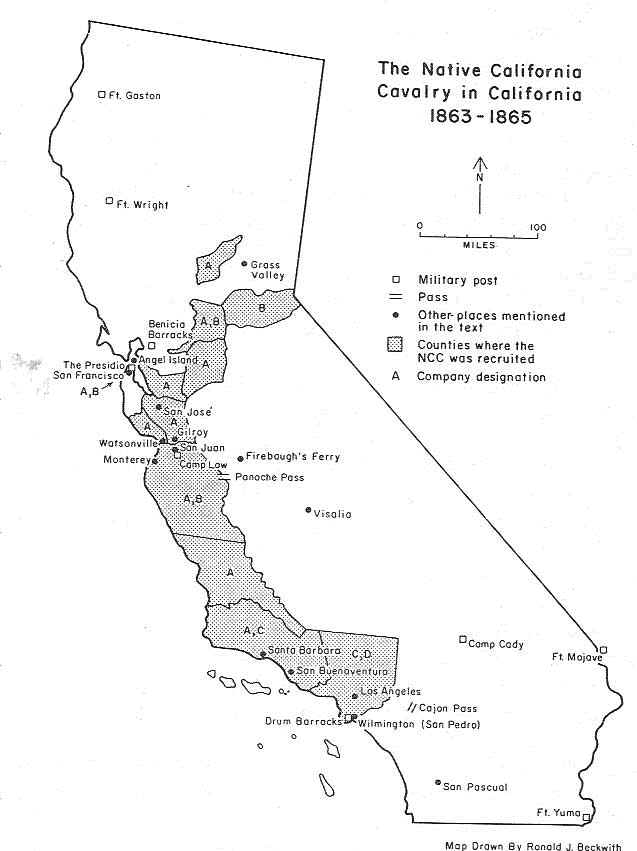
As early on as 1862, California state senator Remauldo Pacheco of San Luis Obispo and Santa Barbara counties had observed that California'due south Mexican-American population (or Native Californians in the vernacular of the day) comprised an exceptional pool of cavalry recruits already well versed in the arts of horsemanship and life in the field. A former officer in the Mexican ground forces and a Matrimony loyalist, Pacheco was eager to requite his fellow Californios an opportunity to evidence their patriotism. He proposed the germination of a regiment of "native cavalry," which would draw recruits from the vast ranches of Southern California and the central coast to serve as lancers in Texas. His novel thought was well received and, in January 1863, the War Section authorized raising a four-company battalion.[three]
Initially, the unit was "to be commanded by a patriotic gentleman, Don Andreas [sic] Pico" The selection was at once inspired and ironic, for Andres Pico had commanded the Californio lancers who humiliated a force of regular cavalry and volunteers nether Gen. Stephen Watts Kearny at the battle of San Pascual in 1846. In the process, they not but gave the United States its simply clear defeat of the Mexican State of war, only too forced the previously unimpressed Americans to recognize the skill and mettle of the California vaquero. [four]
Pico'due south popularity and Union loyalty made him a skilful choice for the position. The aged caballero was not sufficiently healthy, notwithstanding, to ride a equus caballus or perform many of the other duties required of a field commander, and he never accepted his major'southward commission. It was not until the recruitment of the battalion was underway in August of 1864 that Maj. Salvador Vallejo replaced Pico. Similar Pico, the crusty Vallejo was a member of an old and established Californio family. On the other manus, Vallejo seemed an unlikely choice for command because of his disdain for all things Anglo. Don Salvador was amend known for his conflicts with American squatters on his Napa Valley property than for his admiration of the Union cause. It seems likely, given Vallejo's sentiments, that Confederate overtures to the French backed imperialist government of United mexican states drove the dignified curmudgeon to set aside his hostility and don the bluish uniform of a United States Army officeholder. [5]
Even as the paper battalion languished without a commander, a few prominent citizens, Californio and otherwise, took the initiative and began gathering recruits for the four companies. Jose Ramon Pico, a nephew of Andres and who after claimed to have also fought at San Pascual, enthusiastically started the process of organizing recruits weeks before official blessing for the unit of measurement had come dorsum from Washington, D.C. In a flowery letter to Governor Leland Stanford, Pico cited his credentials as a partisan Republican and, without the slightest hint of humility, demanded a captain's commissions [half-dozen]
Stanford granted the request, and Captain Pico immediately gathered recruits at his personal expense. On March 3, 1863, at his headquarters on the plaza in San Jose, he spoke to an assembled crowd in the "soul-stirring" manner for which the men in his family were renowned:
Sons of California! Our country calls, and we must obey! This rebellion of the southern states must be crushed; they must come back into the union and pay obedience to the Stars and Stripes. United, we will, past the strength of circumstances become the freest and mightiest commonwealth on earth! Crowned monarchs must be driven away from the sacred continent of free America!
The mention of "crowned monarchs" was an obvious reference to the emperor Maximilian, who enjoyed non only the support of France and conservatives in United mexican states, but apparently of the Rebel authorities in Richmond too. Conspicuously, Pico sensed that sentiments linking Purple Mexico and the Confederacy as common enemies of California were rife inside the Spanish-surnamed community.[vii]
Pico's rant and fiery rhetoric "infused with martial spirit" the Native Californians of San Jose. Even before his voice communication, Pico had already enlisted more than fifty recruits, generally from the San Jose expanse. Many of the Califormos showed upwards with their lassos, "a novel weapon of offense. . . which they are exceedingly expert at using on horseback." The eighty-one recruits of Company A trained at the Presidio of San Francisco that summer. By August, a dozen men had deserted, a sign of troubles that would plague the battalion during its entire beingness.[8]
Although the enlistees were skilled horsemen, trained and drilled as lancers, it is unlikely that Company A was quite what Senator Pacheco had in heed when he proposed a unit of "native" cavalry. Many of the Spanish-surnamed recruits were strange born, primarily from United mexican states and Republic of chile, and seem to have been former miners. The unit contained a number of non-Hispanic recruits as well. A San Francisco announcer later described the visitor as "truly a mixture of colors and tongues, the men rugged and hearty-more half being native Californians and the remainder Mexicans, Chilenos, Sonorans, California and
Yaqui Indians, Germans, Americans, etc." [ix]
In Dec, the colorful lances adorned with red pennons were replaced past Sharp's carbines and Company A sailed north by steamer to Humboldt Bay, where it joined an ongoing entrada confronting the Hupa, Wintun, and other Indians in the northern region of the state. Its duties in the redwood country included escorting prisoners, livestock, and supply trains, merely little bodily fighting. While the company was posted at Fort Gaston in February 1864, four more men deserted and this time robbed a local civilian. A detachment rode out in pursuit and speedily apprehended the culprits.[10]
While Company A campaigned in the northern role of California, Capt. Ernest Hippolite LeGross was recruiting Visitor B in San Francisco. A French departer who had served with the Corps d'Afrique in Algeria and the Crimea, he was commissioned in office on Pico'due south recommendation. Contrary to Pacheco's original vision for the battalion, the majority of Helm LeGross's original recruits were Frenchmen, including at to the lowest degree two fellow veterans from Algeria. Like Company A, Company B was inducted into federal service at the Presidio of San Francisco, where it remained until January 1865.[xi]
Recruitment of vaqueros from the vast ranches in the southern part of the state-the and then-called "cow counties"-did not brainstorm until early on 1864. A drought had devastated many of the sometime ranches in Santa Barbara and San Luis Obispo counties and even the prominent de la Guerra family was forced to sell much of its vast holdings. Newly unemployed ranch hands from the surface area formed the core of Visitor C, recruited past Capt. Antonio Maria de la Guerra. State Senator Ramon J. Colina, a secessionist elected from San Luis Obispo and Santa Barbara counties, lamented the choice of de la Guerra, pointing out that he "does not even write fluently in his own language, knows not ane word of English, knows not what figures are-but is an experienced horseman." All the same, fifty-fifty Hill afterwards admitted that "the men will not be kept together for any other captain."[12]
Visitor C was very much a de la Guerra family functioning, which explains its high morale and depression desertion rate. Other de la Guerras in the company included Ist Lt. Santiago de la Guerra and 1st Sgt. Juan de la Guerra. Also present was 2d Lt. Porfirio Jimeno, the helm's nephew and stepson of Dr. James Ord, blood brother of a Union general every bit well as a prominent surgeon and rancher. Educated at Georgetown University in Washington, D.C., the twenty four-twelvemonth-old Jimeno was the near intellectually well equipped of the battalion's officers and would evidence to be one of the best.[13]
Mustering of the company was delayed until July because of rumors that raised suspicions most the officers' loyalty. In the intervening 2 months, the already financially strapped Antonio Maria de la Guerra quartered the full-strength company of recruits at his own expense. According to the de la Guerra family and their political allies, the rumors arose from a clique of political rivals, who sought to diminish the de la Guerras' influence past preventing them from receiving officers' commissions. The consequence was apparently resolved by belatedly June and, by late August, Visitor C was on the march toward' Drum Barracks. [14]
Meanwhile, Capt. Jose Antonio Sanchez had already recruited Company D in Los Angeles. He was anxious to reverse the work of his brother, Sheriff Tomas Sanchez, a Democratic Party boss who, early in the war, had provided militia arms to Rebels operating in Arizona and New Mexico. Again taking advantage of anti-imperialist sentiment amongst the Spanish-surnamed Angelenos, Sanchez enrolled eighty-nine volunteers. Every bit with Visitor C, politics and doubts nigh officers' loyalty delayed mustering in until March at nearby Drum Barracks. At the aforementioned time, Juan J. Moreno, another prominent local citizen, took the initiative in Apr and recruited forty men for a Los Angeles visitor. But afterwards languishing at Pulsate Barracks without whatsoever word from department headquarters, Moreno and his volunteers evidently lost interest in federal service and dispersed past the end of May. [15]
Sanchez'south enthusiasm for armed forces service also quickly waned. Already overwhelmed by the paperwork involved in commanding a company, in June Sanchez and 1st Lt. Jose Redona resigned in frustration over what they saw every bit poor handling of their men, exacerbated by a currency crisis in Los Angeles caused by an influx of well-nigh worthless federal scrip. While Sanchez remained active in promoting the Union cause in secessionist southern California, command of his men went to Capt. Edward Bale, promoted from Company B. A native-built-in Californian skillful in Spanish, Bale was respected in the Californio community [sixteen]
In September, de la Guerra'south Company C joined Bale'south Company D at Drum Barracks. Mail commander Col. James Curtis apparently had a low opinion of the native troopers and put them to piece of work on a massive irrigation project to carry water from the San Gabriel River to Wilmington. Although other officers protested the treatment of the Californios and the use of federal soldiers for a private project, the structure continued until January 1865 with the troopers also marching in parades and patrolling the waterfront and guarding federal property at nearby San Pedro amd Wilmington. [17]
Frustrated by ditch digging and the full general dullness of service, Major Vallejo resigned at the terminate of Feb, gruffly dismissing his tour of duty as "devoid of involvement." Iii weeks later, Maj. John C. Cremony transferred from the 2d Cavalry, California Volunteers, and took command of the battalion. [eighteen]
Although an Anglo, Cremony possessed many avails that well-suited him for his new command. First, he was adept at languages, including Castilian and 4 other tongues. Second, the colorful officer and erstwhile announcer seemed to sympathize and have a fondness for the Californios, even affecting the flamboyant apparel of a vaquero. Third-and maybe most important in the coming year-he was a veteran campaigner in Apacheria, including a stint (1851-1852) as interpreter for the Bartlett Boundary Commission, equally well as his more celebrated (and exaggerated) part with the California Column in 1862. [19]
As it happens, Vallejo quit just as things were condign more interesting for the battalion. In November of 1864, bandits John Bricklayer and Jim Henry held up a phase on the road from Watsonville to Visalia, killing three men and vowing to "slay every Republican they would come across." Under the pretense of being Confederate guerrillas, Mason's and Henry's gang terrorized Monterey County and its environs for the next several months.[20] Company B, newly posted to Military camp Depression at San Juan, comprised the entire cavalry forcefulness in the canton. In a letter to Governor Frederick Low, post commander Maj. Michael O'Brien, Sixth California Infantry, described the arrival of the troopers in late January 1865:
The gay and gallant Castilian lancaroes [sic] came dashing through the town with the lances in their manus, a flag flying from each of them. I assure you that they presented a warlike appearance, the people here had never seen a soldier in their lives-Yes sir! they fifty-fifty stampeded the Castilian cattle that were so poor before that they could scarcely stand alone.
Shortly thereafter, O'Brien received intelligence almost the location of Mason's and Henry's hideout. Early on one Dominicus morning time a detachment of a dozen Native cavalrymen under 1st Lt. John Lafferty rode out to observe the bandits. Unfortunately, Lafferty was unsuccessful and the gang connected its depredations.[21]
Meanwhile, drastic changes were taking place for Visitor B. In March of 1865, Captain LeGross resigned in the face of failing morale that produced forty desertions in a little less than a yr. Promoted from Company C, Capt. Porfirio Jimeno, the new company commander, replaced the mostly French and Anglo deserters with Hispanic recruits. This improved morale somewhat by making the company more "native" in character.[22]
In Apr, word arrived at San Juan that the Mason-Henry gang had struck at Firebaugh's Ferry. Captain Jimeno, temporarily in command of Camp Depression, sent Lieutenant Lafferty and a detachment of five men in pursuit of the bandits. Hoping to cut off the gang at Panoche Pass, the lancers rode south along the western flank of the Diablo Range and encountered Mason the next morning. As the bandit spurred his horse in a drastic attempt to escape, Lafferty fired, wounding Mason in the hip and felling his mount with a single bullet. Although the soldiers captured the outlaw'south horse, somehow Mason managed to elude them. At six that evening, Lafferty and his troopers returned to Campsite Low with the horse in tow. Captain Jimeno boldly vowed to continue the pursuit of Mason and Henry, unaware that he and his new command soon would be otherwise occupied.[23]
Similar troubles erupted in the Mohave Valley, where secessionist sentiment ran high, and Chimehuevi Indian depredations plagued the local residents. In response, Helm Bale and Company D were sent to Camp Cady on the road from Cajon Pass to Fort Mohave. Only thirty of Bale's men were mounted as cavalry; the bulk of the company served on pes and was equipped with model 1842 muskets left over from the Mexican State of war. The Californios performed routine garrison and patrol duties through March and were back at Pulsate Barracks by April ix, in time to prepare for a new assignment.[24]
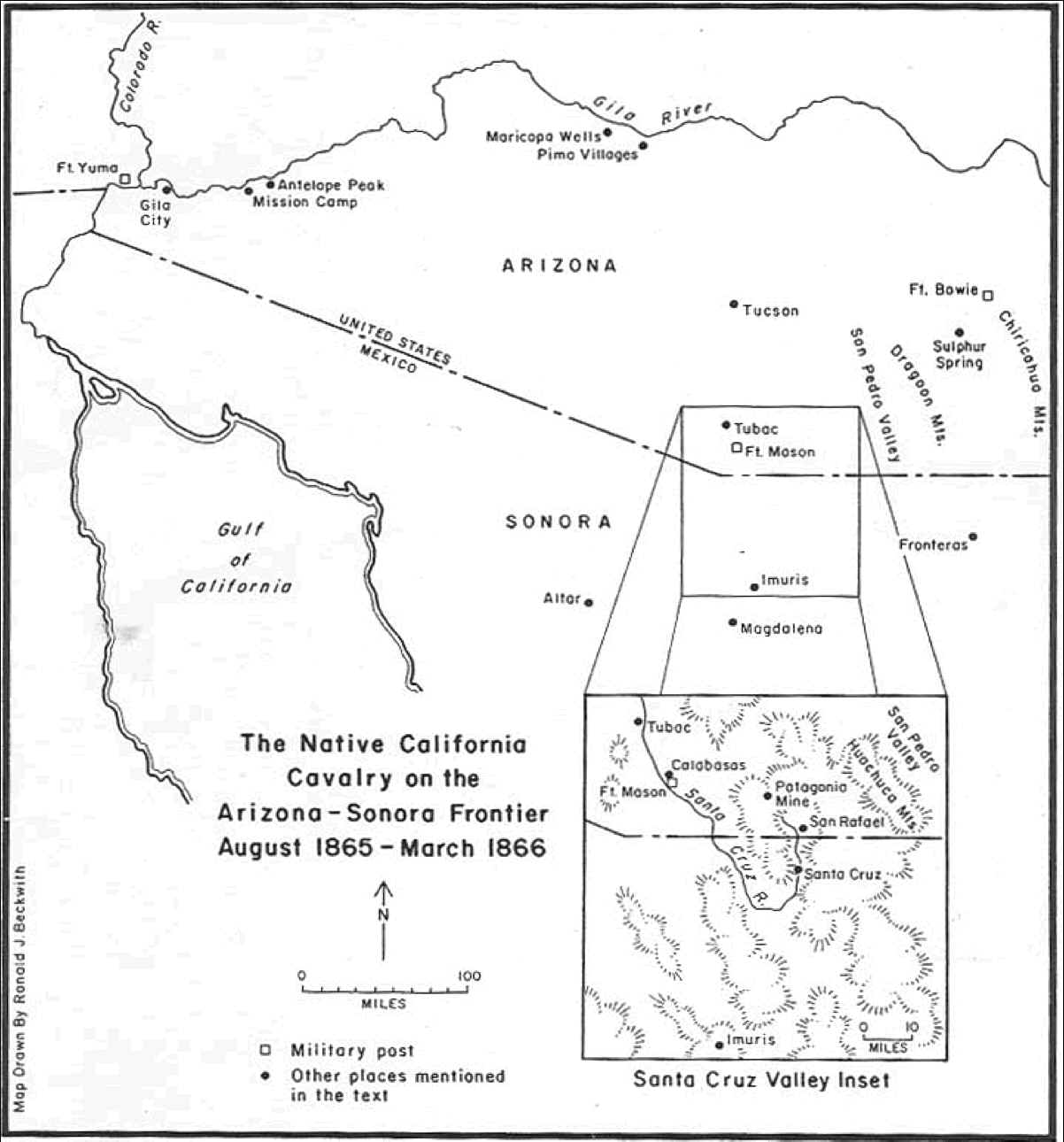
In March 1865, Brig. Gen. John Southward. Bricklayer, newly appointed commander of the District of Arizona, announced that the battalion of Native Cavalry would be traveling e to fight Apaches. Visitor A assembled at Benicia Barracks on the oral fissure of the Sacramento River in early April, where it began preparations for the almost thousand-mile march. Meanwhile, Major Cremony arrived at Campsite Low with headquarters and Company B.[25]
Reports of President Abraham Lincoln's bump-off reached the Due west Coast on Apr xv, delaying the departure of the two Native companies. Major Cremony, Helm Jimeno, and Lieutenant Lafferty served on the committee that planned Monterey Canton's memorial observance, and on Apr 19, Visitor B participated in a procession through the streets of San Juan. Meanwhile, detachments of both companies were assigned to quell violence and arrest men defenseless "rejoicing" at the news of the president'southward death. Disturbances occurred across the state, and in response, detachments were sent equally far away every bit Grass Valley, where 20-five troopers of Company A under Lt. Marcelino Jimenez arrested 10 individuals after a skirmish that left two Native Cavalrymen wounded.[26]
By June, companies A and B were united at San Juan. On June 3, the eve of the Californios' scheduled divergence for Arizona, two secessionists arrested in the wake of President Lincoln's expiry escaped from the Army camp Low baby-sit business firm. Major Cremony detailed both companies to hunt for the fugitives. After a week of fruitless searching, on June 16, troopers began the long march that would have them first to Drum Billet and and then to their new station at Tubac, Arizona Territory. Although they were expected at Pulsate Billet past the 4th of July, the cavalrymen marched leisurely southward along the coast, their footstep slowed non and so much by their sizeable stock train that included "14 fine mules and some 300 horses," as past their frequent stops for fandangos and bull-versus-bear fights.[27]
The arrival of Major Cremony's column at Drum Billet on July 9 represented the first time that the Commencement Battalion, Native California Cavalry, was assembled in one place. Companies C and D were now fully mounted and armed, thanks in part to Captain Pico's uncle, don Pio Pico, who supplied the garrison with horses. Capt. Thomas Young, a veteran of service in New Mexico and Arizona, was now in command of Company D, replacing Captain Bale who had resigned in May. [28]
Like the California Column three years earlier, the Native California Cavalry departed at staggered intervals in order to conserve h2o and forage on its journeying across the desert. Visitor A left Drum Barracks on July 13, followed by Visitor B on the fifteenth and Visitor D on the twenty-start. For reasons that are unclear, Company C with Major Cremony and his staff remained behind until September. During the ii-calendar week march to Fort Yuma, the three companies spread out for seventy-five miles along the famous Overland Road. [29]
Captain Jimeno, for i, questioned the wisdom of crossing the Mojave and Sonoran deserts in July and August. In a letter home, the gloomy and cynical commander of Company B warned his uncle Pablo de la Guerra of the perils of such a journeying:
For Sky's Sake never come out hither if y'all tin can help information technology; you will surely cook. Thermometer every day in the shade 112 to 116-wind none-Scorpions thick as molasses, flies still worse and when we want to beverage cool h2o we have to boil it and drinkable information technology immediately or else it will get hotter. Es imposible dan una description de esta punto. [30]
Dallying at Fort Yuma only long plenty to bivouac for a few days, the Californios continued on toward Tubac. The route would take been familar to the ancestors of near of the California-born men of the battalion, besides as to many of the troopers of Mexican nativity, since it was the same route they had followed in the opposite management from Sonora to California years earlier. On August 9, Visitor D once over again took up the rear of the column, escorting a supply train that included two lite arms pieces.[31]
Six men deserted Company A during the first five days out of Fort Yuma, while Company B lost twenty men. Because the desertions occurred as the column passed through the lower Gila Valley, where the prosperous but short-lived mining camp of Gila City had existed just a few years before, information technology may be that the abscounders, some of whom were ex-miners, ran away to try their hand at placer mining, either near Gila City or a few days north at La Paz. Information technology is besides possible that some of the fugitives fled due south along the Camino del Diablo, which linked up with the Overland Road in the same surface area, and sought sanctuary in Sonora.[32]
A night march across the forty-mile desert, a calendar week or so out of Fort Yuma, brought Company D to the Maricopa villages. Later on more than three weeks on the trail, the Native cavalrymen cast envious eyes on the melons ripening in the fields. According to 1st Sgt. Juan Robarts, the "men having a sneaking regard for the fruit," but having no hard currency, paid the enterprising Indians with "their shirts, drawers, and other articles of wearing apparel." In Robarts's estimation, the Maricopas "got the all-time of every trade that was made."
Arriving in the Onetime Pueblo on August 30, Robarts had goose egg prissy to say near what he sarcastically referred to as the "flourishing and extensive city of Tucson." After a day's residuum, Company D resumed its march south on September ane. Two nights later, a corporal on guard duty spotted "eight or ten" Apaches, the Califormos' first run into with the desert warriors. Plain the Indians had "only come to see if they could find a equus caballus or mule loose, or picketed outside of camp," and nothing came of the brief sighting.[33]
The following twenty-four hour period the Los Angeles company arrived at Tubac, only to find the ancient presidio all but abandoned and the armed forces postal service moved a dozen miles south to the quondam hacienda of Calabasas. There they joined companies A and B and three companies of the 7th Infantry, California Volunteers, all nether the command of Lt. Col. Charles Lewis, a competent and decisive officer who led the "Hungry Seventh." [34]
Named Fort Stonemason afterwards Gen. John Southward. Stonemason, who commanded the District of Arizona from his Fort Whipple headquarters near Prescott, the new post could hardly exist called a fort, consisting instead of tents and brush shelters and but a few permanent buildings. The site, selected by Colonel Lewis, was the erstwhile location of Camp Moore, occupied past two companies of the Beginning Dragoons for a few months in 1856.
Lewis probably did not foresee the problems that would plague Camp Mason. Unusually heavy monsoon rains in August and September swelled the Santa Cruz River and its tributaries. Water that accumulated in the arroyos and cienegas provided an platonic environment for musquito-borne fever that prostrated the garrison throughout the fall and winter. Five enlisted men of the Native California Cavalry and two of its officers, 1st Lt. Crisanto Soto of Company A and Capt. Thomas A. Young of Company D, eventually died of the illness. At i point, between 1-third and half of the garrison was laid low. The fever slowed structure of the post to a well-nigh standstill and delayed serious forays against the Apaches.[35]
Despite its problems, Fort Mason was strategically located on the nigh important road leading from Tucson into Sonora. Stationed at an of import listening post less than ten miles from the border, the men of the Native California Cavalry found themselves only a few hours ride from Mexico, a nation occupied past a foreign power and mired in turmoil that threatened the United States.
Sonora was then far removed from Mexico'southward central government that in many means it was effectively contained. The political chaos that consumed the rest of the country did not leave the borderland province untouched, nevertheless. Governor Ignacio Pesquiera, a Liberal of convenience, had been fighting to retain the governorship since 1855 against partisans of his predecessor, Bourgeois Manuel Gandara, who sought forcibly to unseat him. Gandara's back up complanate in 1861, and he was exiled merely in fourth dimension to miss the coming French invasion.A supporter of the Republicans under President Benito Juarez, Pesquiera was friendly to the Union cause during the American Ceremonious War. He resisted overtures from Confederate agents and cultivated friendships with federal officers, including Colonel Lewis and Col. James Carleton of the California Column. These amicable relationships were born not only out of pragmatism, only also out of partisanship, for the French-backed Imperialists maintained ties with the Confederacy, while the Union generally favored the Republican faction. [36]
While Sonora remained more or less unaffected past the war in central United mexican states, Pesquiera managed to retain his governorship during the early on office of the French Intervention. That changed in 1865 when French regulars landed at Guaymas in hopes of seizing the fabled Sonoran silver mines and using the loot to defray the high cost of supporting Maximilian'south monarchy. The French movements alarmed United states of america officials in California, who had received reports that the Imperialists sought to overturn the Gadsden Purchase and reclaim Arizona. Sonoran Conservatives were encouraged. They assisted a small-merely-disciplined foreign force in destroying Pesquiera's canaille and demoralized ground forces, forcing him
to flee to the safety of his friends north of the border.
Major Cremony, who was non yet present at Fort Mason, afterward wrote an account of Pesquiera's September 6 inflow at the post that seemed to imply that the exiled governor stumbled into American territory with a force of French regulars in rapid pursuit at his heels. The reality seems to take been somewhat different. Accompanying the governor was a sizeable entourage that included his family, sheep, goats, a 1000 head of cattle, a hundred horses, and a military escort. Col. Federico Ronstadt, an infantry officer in the Republican army, rode alee of the party and requested permission to military camp in the valley beneath Fort Bricklayer. Co-ordinate to Sergeant Robarts of Company D, "Colonel Lewis replied that he and his officers would do themselves the honour to look on the Governor of Sonora, which accordingly they did, and offered the protection and hospitality of the postal service." Pesquiera camped with his entourage in the shadow of the fort before briefly taking up residence at the nearby hacienda of Calabasas. He then moved on to Tubac and established a sort of capital in exile, where he could gather financial resources and recruits for a new army. [37]
Meanwhile in Sonora, Jose Moreno, prefect of the armed services district of Altar, moved "300 or 400 Mexican Imperialists" to Magdalena, some fifty-five miles south of Fort Stonemason, plain with the intention of crossing the border to seize the governor. Colonel Lewis belligerently declared, "Allow him come up and try it!" War seemed inevitable, and the boredom and misery of garrison life but amplified the tension. [38]
The situation may have been likewise much for fifteen men of companies A and B, who deserted before long after Pesquiera's inflow and fled south with thirty horses and "numerous" pistols and carbines. Receiving word that the deserters were at Magdalena, Captains Pico and Jimeno, along with Lt. William Emery of the Seventh California Infantry and thirty men of Company A, Native California Cavalry, set out to recover the deserters and the stolen holding.
A two-day ride brought the detachment to the outskirts of the Sonoran community, where Captain Pico sent Emery forrad as a messenger. Impatient for Emery's return, Pico selected eight to ten men and charged into the town. Stopping in front of Prefect Moreno'due south role, the Californio boldly demanded the return of the deserters and stolen belongings, as well as prophylactic passage for himself to Altar and Hermosillo. During the ensuing heated argument, Pico arrogantly declared that as an American officer, he did not recognize the Regal regime. A oversupply that assembled in the plaza cheered the blue-coated invaders. Similar everyone else in Magdalena, Moreno assumed that Pico was there to start a fight. Consequently, he assembled ten to twenty cavalrymen in a line reverse the Californios and sent for an infantry detachment camped nearby. "A unmarried gun fired at this moment would have started a general fight," ane California soldier later wrote.
For some reason, perchance the intervention of the cooler headed Lieutenant Emery, the situation calmed somewhat and Prefect Moreno agreed to send a courier to Hermosillo for instructions. Captain Pico, for his role, agreed to send Captain Jimeno and the bulk of the detachment, who still remained outside the town, back across the line. During the eight-solar day expect for the messenger to return, Republican sympathizers in Magdalena treated Pico, Emery, and the small escort of Native cavalrymen who had been permitted to stay with them to "iii fine dinners." Pico's asking for safe passage into the Sonoran interior was refused and the proud Californian was forced to return abode empty-handed. On the way back, the Californios spotted five Apaches in the hills overlooking the road. Then that the trek would not be a full loss, Pico ordered his troopers to give chase. Lieutenant Emery narrowly escaped injury every bit his horse lost its footing on the steep and rocky incline. Captain Pico burned himself severely when his pistol discharged equally he savage with his equus caballus. The incident no uncertainty humiliated Pico, who had a reputation as one of California's finest horsemen. He called off the chase and the humbled Californians returned to Fort Bricklayer on September xv. The next solar day, word arrived that Moreno'southward men had auctioned off the federal property the deserters had stolen. [39]
In the wake of Imperialist protests against Pico's belligerent behavior and an apparent accompanying buildup of French and Imperialist troops nearly the border, Colonel Lewis established an outpost at Sylvester Mowry's recently abandoned Patagonia mine and sent a twenty-man detachment from Company D to patrol the line. Meanwhile, a rumor reached California that Pico was being held prisoner in United mexican states and would be executed by the French-backed Imperialists at Hermosillo. [twoscore]
Major Cremony finally arrived at Fort Mason, together with Captain de la Guerra and Visitor C, in early on November. A three calendar week filibuster at Fort Yuma-possibly due to flooding-and Cremony's visit with the bilious Governor Pesquiera at Tubac had slowed the march from Pulsate Barracks. Now the Native California Cavalry battalion was once again assembled, just in time to respond to a threatened Imperialist invasion of southern Arizona. [41]
Late on the night of Nov 24, discussion reached Fort Mason from Patagonia that a large Sonoran force had attacked the ranching community of San Rafael, but northward of the edge. Near 350 Opata volunteers under the command of Col. Refugio Tanori, an Opata leader deputed in the Imperial Army, had crossed the line on an patently botched raid that left an American citizen wounded. Believing that the raid was an endeavour to capture Pesquiera, Major Cremony quickly assembled a detachment from companies C and D and rode across the Patagonia Mountains, reaching San Rafael early the next morning. From there, Cremony crossed the border and entered the town of Santa Cruz, where he learned that Tanori's command had retreated further south. The major sent ahead 1st Lt. Edmund West. Coddington of Company D and ten troopers to brand contact with the Imperialist colonel. After a twoscore-mile ride, the troopers reached Imuris just to find that Tanori and his irregulars had melted into the countryside. After resting a few days at Santa Cruz, the control returned to Fort Stonemason, where it arrived on Nov 30. [42]
By the fourth dimension of Tanori's raid, the French regulars had largely withdrawn from Sonora. Pesquiera and the Republicans, while, had successfully raised a small army to claiming Imperialist say-so in the frontier state. Increasingly through December and January, Republican forces engaged the Imperialists in battle in the center of Sonora. Although the war was far from over, the Imperialists would never again molest the northern regions.[43]
At the aforementioned time, frontier privations and the specially miserable conditions at Fort Mason took their toll on the men of the Native California Cavalry. Company returns signed by Cremony in December testify a battalion that, although fairly well disciplined, was scarcely prepare to fight. Artillery for companies B, C, and D, including the distinctive lances that were once such a source of pride, were listed every bit unfit for service. Accoutrements and clothing were also in bad shape. Despite the Californios' axiomatic unreadiness for field service, General Bricklayer was contemplating a entrada against Cochise that involved the 'men of Fort Mason. [44]
For much of the Native Cavalry's service at Fort Mason, the much-talked-about Apaches were nowhere to be seen in the Santa Cruz Valley. A few patrols defenseless glimpses at a altitude of pocket-size parties of less than a dozen, and Captain Jimemo reported killing 1 Apache in a brief exchange in Oct. Cochise had greatly curtailed his activities north of the border, partly in response to the troop buildup during the summer and autumn that accompanied General Stonemason's arrival in Arizona. [45]
Mason'south plan called for troops from Forts Stonemason and Bowie to conduct a ii-pronged campaign confronting the Chiricahua Apaches. Colonel Lewis'due south control, including men from the Native Cavalry and his ain 7th California Infantry, started from Fort Mason in late December, then separate into three detachments that scouted the San Pedro Valley and the Huachuca and Dragoon mountains. Captain Jimeno's cavalry tracked a party of Apaches to an encampment at Sulphur Springs on Christmas Eve. Attacking from ambush, the Californios killed one Indian, wounded two others, and scattered the remainder.
Several days after, Lewis and the balance of the expedition joined Jimeno's troopers at the ambush site. Striking northward and west, the California Volunteers eventually reached Fort Bowie, where they were joined past noted watch Merejildo Grijalva. By January vi, the command was in the field again, tracking Cochise's band in: the Chiricahua Mountains. Although at i point the Californios observed sixty to seventy warriors at a altitude, the Apaches constantly remained a few steps ahead of Lewis'due south troops. The pursuit continued as far due south as Fronteras, Sonora, where the frustrated colonel turned dorsum toward habitation, blaming the expedition's failure on Captain Jimeno, despite the fact that the Native troopers produced the only tangible success of the entrada. Fortunately for Jimeno, department headquarters in San Francisco, unaware that the Chiricahua Apaches had largely withdrawn from Arizona in the pervious months, proclaimed the expedition a success, since it appeared to them that Cochise had been driven into Mexico. [46]
Even before Major Cremony arrived at Fort Bricklayer back in November, orders had been issued for the dissolution of his battalion. On Oct 21, 1865, department headquarters at San Francisco instructed the Native California Cavalry to render to Drum Barracks for mustering out. By early December, detachments that had remained behind to guard federal property at Camp Low, the Presidio, and Affections Island had been relieved by regular troops and discharged. A few more than months would pass, however, earlier regulars arrived in Arizona. So the bulk of the battalion remained at Fort Bricklayer until late January, when it began its long march home. [47]
Reaching Tucson on Jan 31, 1866, the Californios retraced their route along the Overland Road to the Colorado River contrary Fort Yuma, where high water from heavy autumn rains forced them to stop for over a calendar week. As soon as they were able to ford the river and reach the fort, the battalion carve up up, with companies A, B, and D marching overland to Drum Billet, while Major Cremony and Company C boarded a steamer for the Presidio. The Santa Barbara company may have received this special handling because of the poor health of Captain de la Guerra. Suffering from a social disease that he caught some time during his service, the captain had been confined to quarters during much of his stay at Fort Mason and was likely unable to withstand the rigors of a road march. [48]
Lagging behind the other two companies traveling over land, Company D reached Pulsate Barracks on March viii, joining companies A and B who had arrived there a calendar week earlier. Captain Jimeno and Company B were mustered out on March 15; the other two companies were discharged v days afterward. One news paper correspondent tersely summarized the Californios' tour of duty. "They accept done good service," he wrote. [49]
The journey home for Major Cremony and Company C took somewhat longer. Together with a company of the 7th California Infantry and ii companies from the 2d California Infantry, the remaining Californios boarded a Colorado River steamer at Fort Yuma and sailed south to Cabo San Lucas at the tip of Baja California. After a few days stopover, they continued the voyage around the peninsula and and so due north to San Francisco, where they docked on March 27. [50]
At the Presidio on April 2, the men of Visitor C were mustered out, given their back pay, and let loose in San Francisco, where they were "to be seen on every street corner. . . spending their greenbacks with peachy liberality." The ex-lancers, threadbare after their frontier service, spent most of their newly issued scrip at wear stores. [51]
The veterans of the Santa Barbara company were welcomed home with a parade down the dusty lane that would become Land Street and a two-day fiesta in De La Guerra Plaza. The events of the Civil War and their political fallout had given the old families of Spanish California power and prestige that they had not enjoyed since the American conquest. Now, the return of the vaqueros, who had served their country in the best tradition of the valiant lancers of San Pascual, gave the Californios a hazard to gloat this cursory moment when the glory and romance of Quondam California seemed restored. Possibly they knew that it was non to concluding. [52]
Porfirio Jimeno was offered a commission in the postwar regular ground forces, but turned it down. Instead, he went to Mexico, possibly to bring together members of his father's family, or, according to some reports, throwing in with the American Legion of Laurels, a band of ex-California Volunteers who aided the Republican cause in Mexico. Either way, he died a commissioned officer in the Mexican Army at Mexico City in 1870. [53]
Antonio de la Guerra continued to suffer from the illness he contracted in the service. Treated with injections of mercury, he died blind and toothless at age 50-six in 1881. [54]
The other officers and men of the Native California Cavalry returned to their civilian lives. Like most of the California Volunteers, they faded into obscurity, forgotten by nearly everyone except when the proud veterans appeared at the battalion reunions held at Pulsate Barracks until 1923. The final Californio lancer, 1st Sgt. Juan de la Guerra of Company C, died at Santa Barbara in 1945. [55]
Well before Sergeant de la Guerra'south decease, the tradition that the Native Cavalry represented had become a throwback, seen only in pop novels like Ramona and The Mark of Zorro. Even as the battalion served in California and Arizona, the big ranches were being broken up and sold. The stop of the state of war brought an influx Anglos ignorant of California'due south by and thus unable to respect the contributions of their Spanish-surnamed predecessors. The charge of the lancer, with brilliant pennon fluttering in the wind bravado in from the bounding main, had become as quaint a romantic notion as the sprawling rancho and the vaquero. The service of the Commencement Battalion of Native California Cavalry was one concluding chance for the proud California vaquero to ride into glory. [56]
Footnotesi. San Francisco Message, July eleven, 1865; Wilmington Journal, July 1, 8, 1865.
2. Officially, the armament of the lancer companies of the Native California Cavalry consisted of a Filly ground forces revolver, a saber, and a lance manufactured at the Benicia arsenal.
Special Society 65, Headquarters, District of Southern California, Drum Barracks, in The War of the Rebellion: A Compilation of the Official Records of the Union and Confederate Armies, 70 vols. in 128 pts. (Washington, D.C.: Authorities Printing Office, 1880-1901), Serial I, vol. 50, pt. ii, p. 1035 (hereinafter cited as O.R.); San Francisco Bulletin, July 8, 1865.
3. Richard H. Orton, Records of California Men in the War of the Rebellion (Sacramento: State of California, 1890), p. 304; Sacramento Union, January 28, 1863.
4. Orton, Records of California Men, p. 304; Leonard Pitt, The Pass up of the Californios: A Social History of Spanish-Speaking Californians, 1846-1890 (Berkeley: Academy of California Press, 1966), p. 34.
five. Orton, Records of California Men, p. 304; Pitt, Decline of the Californios, pp. 230, 233.
vi. Wilmington Journal, March 10, 1866 J. R. Pico to Governor Stanford, San Jose, January 2, 1863, Box 6, Military and National Guard Collection (MNG), California Archives,
Sacramento.
7. Alta California (San Francisco), March 11, 1863
eight. Ibid., March 11, 20,1863; Orton, Records of California Men, pp. 307-310.
9. Muster and Descriptive Roll, Native California Cavalry (NCC), MNG; San Francisco Bulletin, July viii, 1865.
10. Aurora Chase, The Regular army of the Pacific: Its operations in California, Texas, Arizona, New United mexican states, Utah, Nevada, Oregon, Washington, plains region, Mexico, etc. 1860-1866 (Glendale, Calif.: The Arthur H. Clark Company, 1951), pp. 246-48; A. J. Bledsoe, Indian Wars of the Northwest: A California Sketch (Oakland, Calif.: Biobooks, 1956), pp. 234, 249-51; Alta California, February xviii, 1864.
xi. San Pose Patriot, January 18, 1863. J. R. Pico to Governor Stanford, September 9, 1863, Box vi; and Muster and Descriptive Scroll, Visitor Returns, Company B, NCC, both in MNG.
12. A. Dibblee Poett, Rancho San Julian: The Story of a California Ranch and Its People (Santa Barbara: Futhian Printing, 1990), pp. iii-38. Maj. S. Vallejo to Lt. Col. Richard C. Drum, Drum Billet, April thirteen, 1864; Raymond Colina to Governor Low, Santa Barbara, April 24, 1864; Hill to Full general Kibbe, Santa Barbara, May 16, 1864, Box 7, MNG. Muster and
Descriptive Whorl, Company C, NCC, ibid.
xiii. Constance Wynn Altshuler, Cavalry Yellow & Infantry Blue: Army Officers in Arizona Between 1851 and 1886 (Tucson: Arizona Historical Guild, 1991), pp. 178-79; Stella
Haverland Rouse, "Civil War Volunteers," Noticias (Santa Barbara Historical Society), vol. 27 (Fall 1981), pp. 58-59.
14. Pablo de la Guerra to Low, Los Angeles, May 26,1864; W. 1000. However to Low, Los Angeles, May 27, 1864, Box 7, MNG. Alta California, June 18, September 11, 1864.
xv. Pitt, The Decline of the Californios, p. 231. Jose J. Moreno to Low, Los Angeles, Apr 28, 1864; Still to Low, May 27, 1864, Box 7, MNG. Mail service Returns, Drum Barracks, March 1864, Records of the U.South. Ground forces Commands (RUSAC), Record Group 94, National Athenaeum.
16. William P. Reynolds to Low, Los Angeles, June 9, 1864, Box vii; Vallejo and Pico to Stanford, Presidio of San Francisco, November xxx, 1863, Box six, MNG. Alta California,
June 24, 1864. Post Returns, Drum Barracks, July 1864, RUSAC.
17. Post Returns, Pulsate Barracks, September 1864, RUSAC; Reynolds to Low, Los Angeles, March 28, 1864, Box 7, MNG; Wilmington Journal, January 14,1865; Haverland Rouse, "Civil War Volunteers."
eighteen. Pitt, Reject of the Californios, p. 233; Orton, Records of California Men, p. 301.
19. Altshuler, Cavalry Yellowish & Infantry Blueish, p. 85.
twenty. Parajo Times (Watsonville), Nov 12, 1864.
21. Alta California, January 24, 1865; Michael O'Brien to Low, Camp Low, San Juan, February 1, 1865, Box viii, MNG.
22. Vallejo to Low, Drum Barracks, February 23, 1865; Captain de la Guerra and Lieutenant Jimeno to Low, March 17, 1865, Box eight, MNG. Orton, Records of California Men, pp.
310-xiv.
23. Alta California, Apr 12, xiii, 1865.
24. OR., pp. 1150-51; Postal service Returns, Drum Barracks, March and April 1865, RUSAC.
25. Sacramento Matrimony, March eleven, 1865; Alta California, April 12, 1865.
26. Pajaro Times, Apr 29, 1865; Sacramento Union, April 28, 27, 1865; Alta California, May fourteen, 1865; Orton, Records of California Men, p. 305.
27. Monterey Gazette, June 9, 1865; San Francisco Bulletin, July 8, 1865.
28. Mail Returns, Drum Barracks, July 1865, RUASC. Alta California, April 12, 1865. Company Returns, Company D, NCC, June 1865, MNG; Gilbert C. Smith to Low, May 24, 1865, Box ix, ibid.
29. Wilmington Journal July 29, 1865; Post Returns, Drum Barracks, July-Baronial 1865, RUSAC.
30. Jimeno to Pablo de la Guerra, August 3, 1865, Binder 554, de la Guerra Drove, Santa Barbara Mission Archives.
31. Los Angeles Tri-Weekly News, October 24, 1865.
32. Orton, Records of California Men, pp. 307-314.
33. Los Angeles Tri-Weekly News, Oct 24, 1865.
34. Ibid.; Constance Wynn Altshuler, Chains of Control: Arizona and the Army, 1856-1875 (Tucson: Arizona Historical Guild, 1981), pp. 41-44. 35. Constance Wynn Altshuler, "Camp Moore and Fort Mason," Journal of the Council on Abandoned Military Posts, vol. 26 (Winter 1976), pp. 34-36; Sacramento Union, October 19, 1865.
36. Rodolfo F. Acuiia, Sonoran Strongman: Ignacio Pesquiera and His Times (Tucson: University of Arizona Press, 1974), pp. 79-87.
37. John C. Cremony, "How and Why Nosotros Took Santa Cruz," Overland Monthly, vol. vi (April 1871), pp. 335-40; Los Angeles Tri-Weekly Times, October 24, 1865; Thomas Edwin
Farish, History of Arizona, vol. 4, p. 118, typescript, Special Collections, University of Arizona Library, Tucson; Edward F. Ronstadt, ed., Borderman: Memoirs of Federico Jose Maria Ronstadt (Albuquerque: University of New Mexico Press, 1993), p. 4.
38. San Francisco Message, October 23, 1865.
39. Ibid.; Sacramento Wedlock, October 19, 1865; Los Angeles Tri-Weekly News, October 24, 1865.
40. Returns, Company D, NCC, Oct 31 to December 31, 1865, MNG; Porfirio Jimeno to Josefa Maria de la Guerra, October xxx, 1865, Folder 551, de la Guerra Drove; San Francisco Bulletin, Oct 23, 1865.
41. Muster Roll, Field & Staff, NCC, Baronial 31 to October 1865, MNG; Cremony, "How and Why We Took Santa Cruz," p. 337.
42. Cremony, "How and Why We Took Santa Cruz," pp. 337-twoscore; Wilmington Journal, December 30, 1865.
43. Acuna, Sonoran Strongman, pp. 87-93.
44. Returns, Companies A, B, C, and D, NCC, MNG.
45. Jimeno to Josefa Maria de la Guerra, October 30, 1865, Binder 551, de la Guerra Drove.
46. Edwin R. Sweeney, Cochise: Chiricahua Apache Principal (Norman: University of Oklahoma Press, 1991), pp. 239-40.
47. Sacramento Union, October 26, 1865; Los Angeles Tri-Weekly News, December 15, 1865; Returns, Company B, December 1865, NCC, MNG.
48. Wilmington Journal; February 17, March 17, 1865; Returns, Company D, Jan 31, 1866, Visitor C, October 31 to Dec 31, 1865, NCC, MNG; Diblee Poett, Rancho San Julian, p. 42.
49. Wilmington Journal, March 3, x, 1866; Orton, Records of California Men, pp. 307-14, 317-20; San Francisco Message, March thirty, 1866.
50. Don McDowell, "Vaqueros en Azul," Drumbeats, vol. 3 (October 1989); Alta California, March 27, 1866.
51. Orton, Records of California Men, pp. 315-17; Alta California, April iv, 1865.
52. McDowell, "Vaqueros en Azul"; Pitt, Decline of the Californios, pp. 241-42.
53. Altshuler, Cavalry Yellow & Infantry Blue, pp. 178-79.
54. Diblee Poett, Rancho San Julian, p. 42; McDowell, "Vaqueros en Azul."
55. McDowell, "Vaqueros en Azul."
56. Pitt, Decline of the Californios, pp. 247-76.
Near the Writer- Tom Prezelski is a graduate of the University of Arizona and a docent at the Arizona Historical Guild, Tucson. He presented an earlier version of this article at the 1998 joint New Mexico-Arizona Historical Convention in Santa Iron.
The Pima County Board of Supervisors appointed Tom Prezelski to the House of Representatives in Feb 2003 to fill the vacancy left in Commune 29 past Representative Victor Soltero, who resigned to accept an appointment to a vacancy in the State Senate.
Representative Prezelski is a Tucson native with deep roots in the One-time Pueblo and Southern Arizona. His father had a distinguished xx-two yr career in the United States Air Forcefulness, retiring with the rank of Senior Master Sergeant. His mother, who had a long and varied career at the Academy of Arizona, is a descendent of several pioneer families of the Arizona-Sonora border region, including some ancestors who served as soldiers in the Spanish garrison at Tucson in the 18th Century. His family�south tradition of public service extends at least every bit far back every bit his grandfather, Francisco Ronquillo Villa, a cowboy, rancher, union railroad worker and Cochise Canton Democrat who served on a school board in the San Pedro Valley in the 1930s.
Representative Prezelski is a graduate of the Academy of Arizona, where he was active in the Arizona Students Association and received a degree in Geography.
Representative Prezelski is an amateur historian, and some of his articles accept seen impress. For this article he received the James F. Elliot 2 award for the best commodity by a non-professional historian. He has worked as a docent and volunteer at the Arizona Historical Society in Tucson. He besides participates in a reenactment group that recreates the Segunda Compania de Voluntarios de Catalu�a, a Spanish infantry company that served in what is at present Arizona, California and Sonora in the 1780s. In 1995, he was appointed to the Tucson-Pima County Historical Commission, a board that advises local government near historical and cultural preservation issues in the greater Tucson area.
Representative Prezelski worked as a planner for the Tohono O�odham Nation from since 1999 to 2003.
Representative Prezelski lives in the Barrio Viejo neighborhood of Tucson on the aforementioned cake where his grandmother grew upward.
Source: https://www.somosprimos.com/sp2017/spfeb17/spfeb17.htm
0 Response to "Mapa Con Leyenda De Los Primeros Pobladores Clip Art Mini Arrow Pointing to the Left"
Enregistrer un commentaire