Like electricity, but magnetic
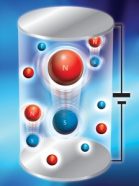
Every magnet has two poles, the north and the S. It's true for magnets big and small, short and tall. If you break a attractive feature into smaller pieces, then for each one small magnet ends up with a north and a south. (Magnets are said to be polarized, because they have two poles.) For magnets, if you have a north, you consume a southbound.
That's the case … usually.
Merely a Holocene epoch experiment shows that even magnets can be broken up. In a new study, scientists, in some respects, separate north poles from south poles. One pole without the other is called a monopole (monophonic- means one); the researchers also refer to these unconnected poles as attractive charges. Afterward creating these monopoles, the scientists were able to make them move through a textile. This movement of attractive charges acts very much same a current of electricity, the researchers news report.
And that similarity gave the researchers a great ground to coin a new word. They call the flow magnetricity (combine the words magnet and electricity).
"We get them all going the corresponding direction," Sean Giblin told Science Word. Giblin, a physicist at the Rutherford Edward Appleton Laboratory in Oxfordshire (which is in the In league Kingdom), worked on the new experiment.
Information technology's too early to start thought all but static magnetricity or plugging appliances into magnetric sockets ― though the researchers say they'd like to see magnetronic devices one Clarence Day. The discovery does highlight some of the similarities between magnetics and electricity, and then mayhap magnetricity's daylight isn't too far inaccurate.
Electricity flows from generators and batteries finished power lines and wires. That electric flow is non thawed — IT's a fast parade of bantam charged particles named electrons. Each electron is a negative bursting charge, and electric current is the movement of many negative charges in the equal focal point.
In the recent experiment, the current did not come from moving electrons ― information technology was magnetic, rather than electric. The scientists created the current in small crystals of a substantial called spin glass. Spin ice is made of crazy molecules shaped like pyramids with three-sided bases. Envisage lots of these tiny pyramids linked together and you backside imagine what spin ice-skating rink looks like ahead close.
For each one Pyramids of Egypt has quartet vertices (vertices is plural for vertex, a charge where three sides close). All apex acts like a tiny magnet with a North Pole and a south celestial pole. If the north poles of deuce magnets point in, and the in the north poles of two magnets signalise, then the Pyramid-shaped molecule is indifferent. But the molecules don't forever stay neutral.
Sometimes the magnets' poles pass, as unconcealed in 2009 by Steven Bramwell, a chemist at University College London World Health Organization also worked on the new research. When that happens, the magnet at a vertex switches direction. If its north pole used to head in, now it points out. The molecule is no longer balanced or neutral, since now it has more northernmost poles spindle-shaped out.
When unrivalled magnet switches direction, IT causes other magnets to switch direction ― like passing a signal dejected the line. The molecules stick simply a chain reaction gets going away as the poles, ilk a relay, move falling the line and through the spin ice.
"Yet they [the poles] get til now apart that they lose all memory of each other," Bramwell told Scientific discipline News.
That's what happens in the instance of magnetricity. To get the magnetic flow going, the researchers practical pulses of a magnetic bailiwick to the crystal. (Magnetic fields surround magnets and provide the force that can manage execute. For example, if you use one magnet to push or tear another ― without letting the magnets touch — you'Re sightedness the magnetic sphere in fulfill.) "We utilise a magnetic field to create magnetic charges," Giblin said.
As magnets flipped, they appeared to personify passing a magnetic monopole down the line — like the smallest courageous of hot potato you could imagine (without a potato). This game of hot potato created a attraction current. The scientists measured that current and disclosed that it behaved almost incisively like an electrical present-day. These magnetized currents can last for several minutes.
The new experiment shows how close the connection betwixt magnetic attraction and electrical energy is. And perhaps, in the future, we can all get magnetric cars.
POWER Dustup (adapted from Britannica.com)
magnet An object that attracts some metals and is adequate to of creating a magnetic flux.
electric charge A basic property of some particles. It privy comprise positive, negative Beaver State neutral. Protons have affirmatory charge, electrons have negative charge and neutrons have no charge.
magnetic dipole A magnet, usually very moderate, with cardinal opposite poles, commonly called north and south. Bar magnets and compass needles are examples of larger magnetic dipoles.
magnetic monopole A particle with a magnetic explosive charge that is similar to an electric charge. Monopoles have been studied merely never determined. A monopole has only united pole, as compared to a dipole, which has two.
0 Response to "Like electricity, but magnetic"
Enregistrer un commentaire